
ApoB vs LDL: why your cholesterol result might not be telling the full story?

If you have ever had a blood test, you have probably seen your LDL cholesterol result. It is one of the most routinely checked markers in medicine, and for decades it has been the standard way to assess cardiovascular risk. A normal LDL result is generally taken as good news.
The problem is that LDL does not always tell the full story. And for a significant proportion of people, it can give a false sense of reassurance.
What LDL tells you and what it misses ?
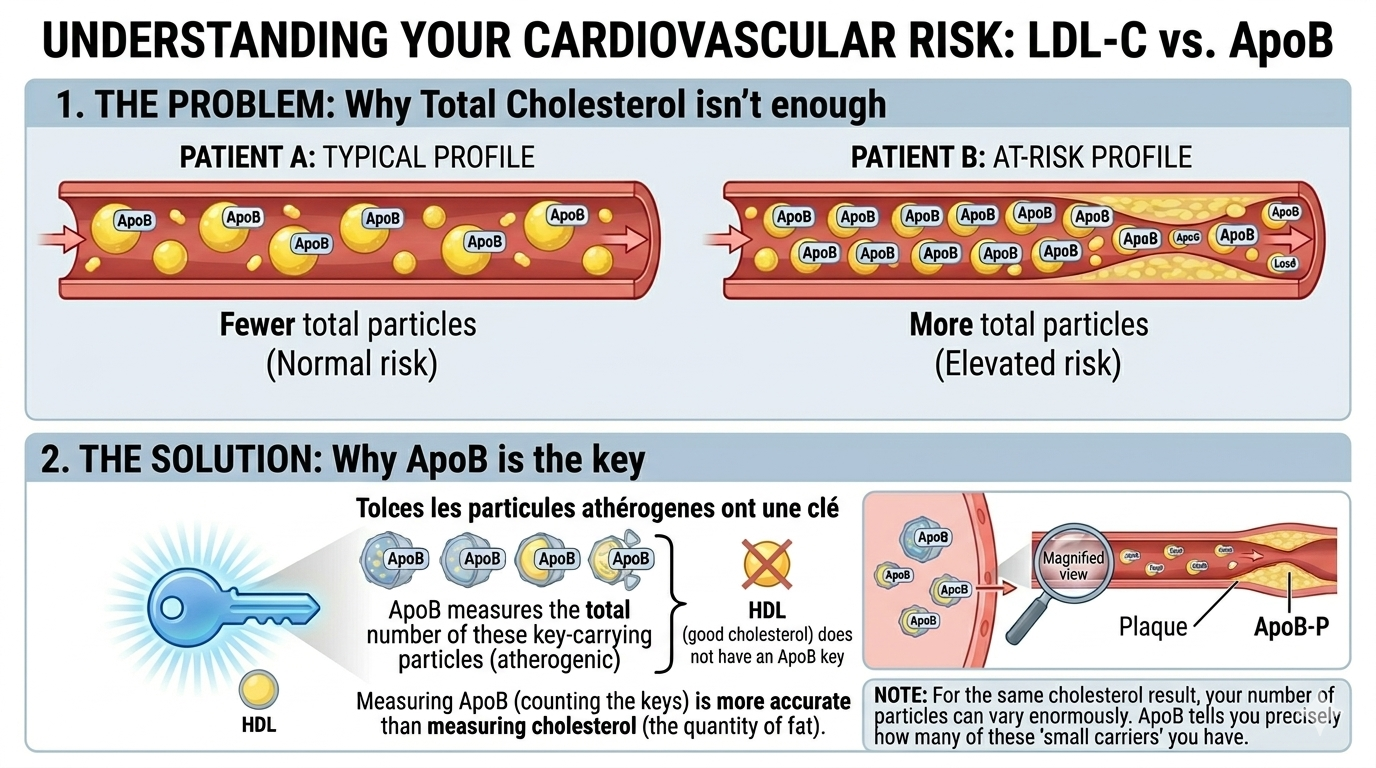
Think of your bloodstream as a motorway. LDL particles are the delivery trucks, and cholesterol is the cargo they carry. LDL cholesterol tells you how much cargo is in transit. What it does not tell you is how many trucks are on the road.
This matters because arterial damage does not come from the cargo itself. It comes from the trucks. Every time an LDL particle brushes against an artery wall, there is a chance it gets stuck, triggers inflammation, and contributes to plaque build-up over time. The more particles there are in circulation, the more often this contact happens, regardless of how much cholesterol each one is carrying.
Two people can have the exact same LDL result and very different numbers of particles in their blood and therefore very different levels of heart risk.
This is not a rare exception. It happens frequently and particularly in people who:
Have elevated triglycerides
Have insulin resistance or prediabetes
Carry weight around the abdomen
Have a family history of early cardiovascular disease
Have been told their cholesterol is "normal" but still feel something is off
What Apo B measures and why it fills the gap ?
ApoB (short for Apolipoprotein B) is a protein found on the outer surface of every atherogenic particle in your blood. Each particle carries exactly one ApoB molecule. This makes ApoB a direct count of the total number of cardiovascular risk particles circulating in your blood. Not an estimate, not a calculation based on cholesterol content, an actual count.
| LDL Cholesterol | ApoB | |
|---|---|---|
| What it measures | Amount of cholesterol carried in particles | Number of risk particles in circulation |
| Reliable for everyone? | Not always | Yes mostly |
| Misses small dense LDL particles? | Often | Rarely |
| Recommended by leading cardiologists? | Standard | Increasingly used |
Research consistently shows that ApoB is a stronger predictor of cardiovascular events than LDL — especially in people with insulin resistance, elevated triglycerides, or a metabolic profile that makes LDL unreliable. Several major cardiology societies now increasingly use ApoB as a standard part of cardiovascular risk assessment. While LDL remains a validated and essential marker, ApoB provides complementary information that is often more precise for certain metabolic profiles.
Who benefits most from knowing their Apo B ?
ApoB adds the most value when LDL alone is likely to give an incomplete picture. Ask yourself:
My triglycerides are elevated. The formula used to calculate LDL becomes unreliable at high triglyceride levels, a limitation rarely mentioned in routine results. ApoB measures your particle count directly, regardless.
I have insulin resistance or metabolic syndrome. These conditions produce a high number of small, dense LDL particles, the most harmful type. Your total LDL may look acceptable while your actual particle count is considerably higher.
I have a family history of early heart disease. If a parent or sibling had a heart attack before 60, your inherited risk may not be visible in a standard panel. ApoB can show whether particle burden is part of the picture.
I have already made changes and want to know if they are working. LDL can be slow to respond to dietary or lifestyle changes. ApoB is a more sensitive early indicator of whether your cardiovascular risk is genuinely improving.
What you can do about an elevated Apo B ?
The good news is that ApoB responds well to targeted nutritional changes and faster than people expect. The key dietary levers are:
Reducing refined carbohydrates and added sugars, which raise particle count independently of dietary fat intake
Increasing soluble fibre from vegetables, legumes, and certain fruits, which improves LDL particle clearance
Replacing ultra-processed fats with extra virgin olive oil, associated with improvements in both particle quality and inflammation levels
Regular physical activity, which improves insulin sensitivity and shifts LDL particles towards a less harmful profile
These are not generic lifestyle tips. They are specific interventions that work at the level of particle biology which is why knowing your ApoB first makes the difference between targeted action and guesswork.
Learn more about the Metabolic Check-upSources
Sniderman AD et al. A meta-analysis of low-density lipoprotein cholesterol, non-high-density lipoprotein cholesterol, and apolipoprotein B as markers of cardiovascular risk. Circulation: Cardiovascular Quality and Outcomes, 2011.
European Atherosclerosis Society Consensus Panel. Lipids and lipoproteins in cardiovascular prevention. European Heart Journal, 2020.
Metabolic Check-up
ApoB, insulin resistance, chronic inflammation — the markers that reveal your cardiovascular risk years before symptoms appear.
ApoB · HOMA index · hsCRP · Full lipid panel · Cortisol
Complete overviewFull Body Scan
Over 50 biomarkers in a single blood draw — including cardiovascular and metabolic markers for a panoramic picture of your health.
ApoB · Lipid panel · Thyroid · Liver · Kidneys · Hormones · Blood count
No prescription needed · Zurich & Geneva · Results in 3 to 7 days