
Why a Preventive Check-Up Is Not Just a Blood Test
For many people, a blood test is still seen as a one-off medical act: checking whether “everything is normal,” getting reassurance, and moving on.
When it comes to preventive health, however, this approach is limited and often misleading.
A preventive check-up is not designed to diagnose disease or to look for acute pathology. Its purpose is to understand how the body is functioning, to identify early biological imbalances, and to monitor their evolution over time.
This represents a fundamentally different use of laboratory medicine.
Screening biology vs preventive biology
In conventional clinical practice, laboratory tests are primarily used to:
confirm or rule out a diagnosis,
detect disease,
monitor known medical conditions.
Results are therefore often interpreted in a binary way: normal / abnormal.
Preventive biology, as practiced at Labology, follows a different logic:
identifying biological trends rather than isolated abnormalities,
interpreting biomarkers in relation to one another,
understanding what the body expresses before symptoms appear.
A result within the reference range does not necessarily mean optimal health. Conversely, a slightly out-of-range value is not automatically pathological.
2. Reference ranges do not define optimal health
Laboratory reference ranges are statistical intervals, derived from large and heterogeneous populations.
They describe what is common, not what is optimal for a specific individual.
This has two important implications:
A person may experience fatigue, reduced performance, or poor recovery despite “normal” laboratory results.
A mild deviation from the reference range may have no immediate clinical significance.
Preventive medicine operates precisely in this grey zone, where classical diagnostic medicine has little to say.
3. A single biomarker rarely tells the full story
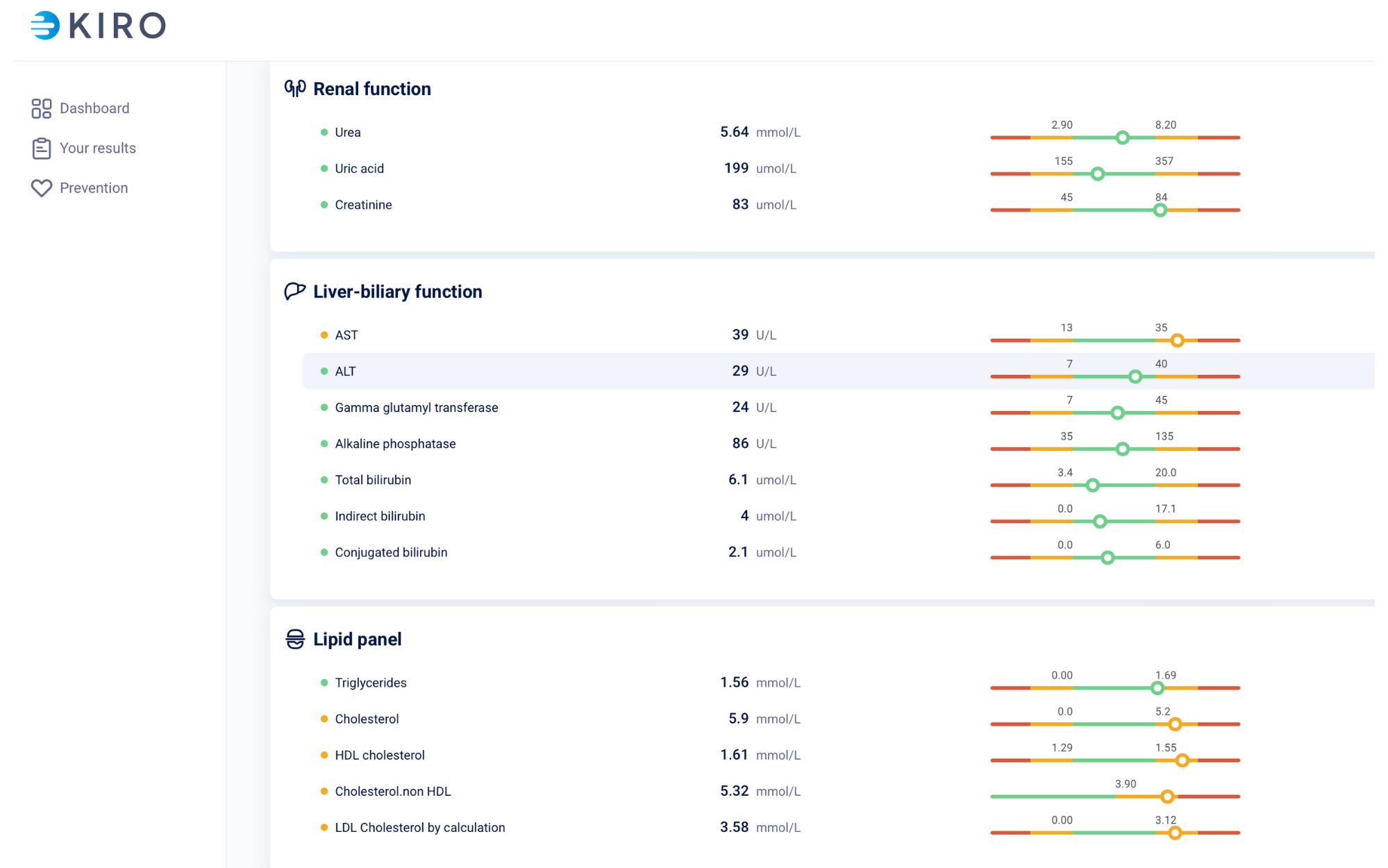
A laboratory value in isolation has limited meaning.
Common examples include:
LDL cholesterol interpreted without metabolic, inflammatory, or family context.
Ferritin assessed without considering inflammatory markers such as CRP.
TSH measured alone, without evaluating overall thyroid function.
The value of a preventive check-up lies in a system-based interpretation:
metabolic health,
inflammation,
liver function,
hormonal balance,
nutritional status.
It is the interaction between biomarkers that provides clinically meaningful insight.
4. Health is a trajectory, not a snapshot
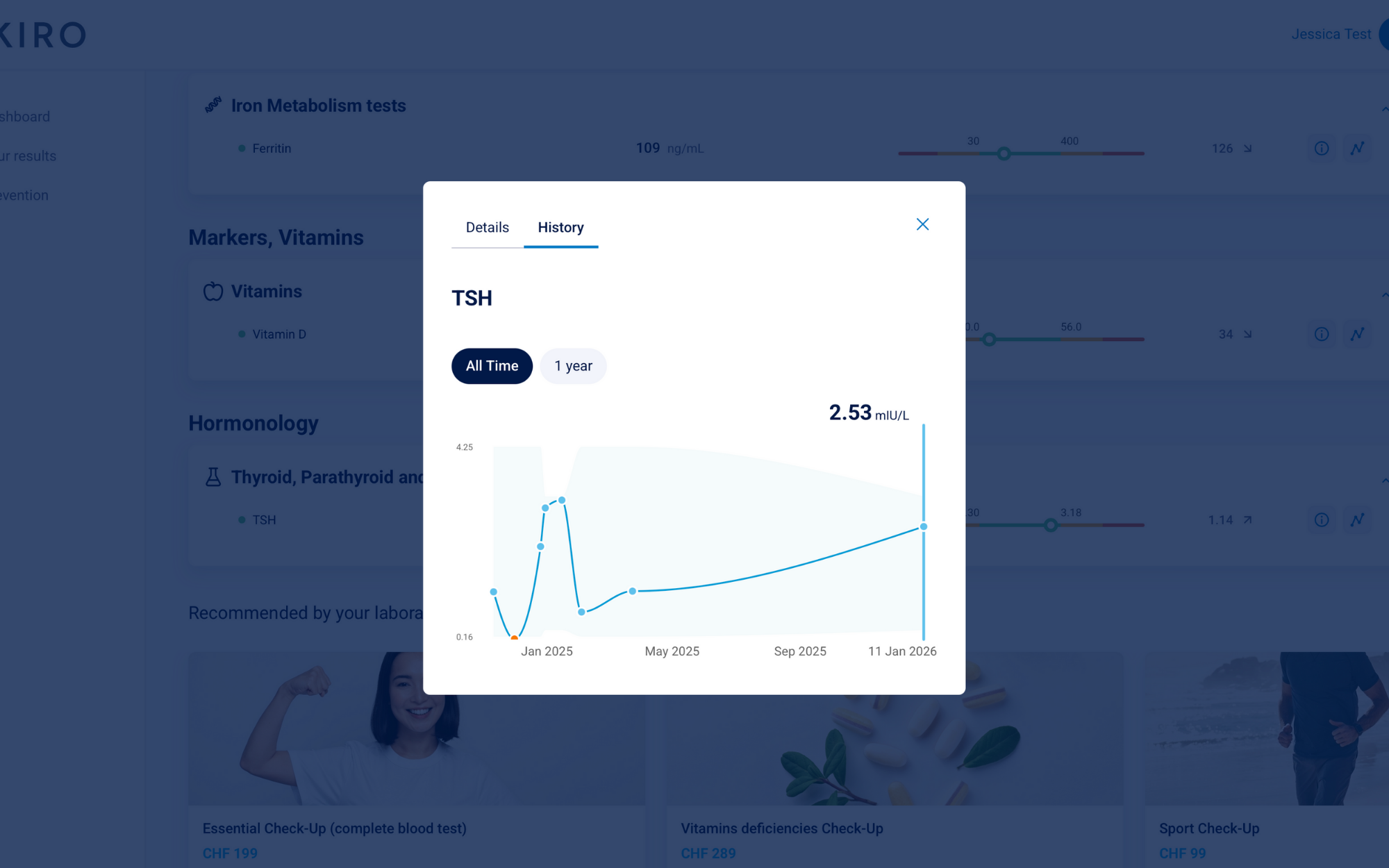
Every blood test is a snapshot taken at a specific moment in time.
Human biology, however, is dynamic.
A preventive check-up becomes truly relevant when results are:
repeated over time,
compared with previous measurements,
interpreted as part of a biological trajectory, not a verdict.
A gradual rise in blood glucose, a slow decline in iron stores, or persistent low-grade inflammation is often more informative than a single abnormal value.
Prevention is based on recognizing and acting on these trends.
5. Acting before symptoms appear
Most biological imbalances do not cause immediate symptoms.
Fatigue, reduced concentration, impaired recovery, or sleep disturbances often emerge after years of gradual dysregulation.
The role of preventive laboratory testing is to:
identify early biological signals,
understand their underlying mechanisms,
guide simple, targeted adjustments.
The goal is not to treat disease, but to reduce the likelihood that disease will develop.
in Conclusion: From Numbers to Meaning
A preventive check-up is neither an anxiety-driven screening tool nor a diagnostic test.
It is a tool for understanding, monitoring, and informed decision-making.
The value of laboratory testing lies not in whether a result is “normal,” but in:
how biomarkers relate to each other,
how they evolve over time,
how they are interpreted within an individual context.
This nuanced, evidence-based, and non-alarmist approach is what gives preventive laboratory medicine its true relevance.
-
No.
A preventive check-up is not designed to diagnose disease or replace a medical consultation.Its purpose is to:
assess biological balance,
identify early deviations or trends,
support informed health decisions.
Diagnosis requires a clinical context, symptoms, and sometimes imaging or further investigations. Preventive laboratory medicine focuses on risk identification and monitoring, not on labeling disease.
-
Not necessarily.
Reference ranges are statistical intervals, typically covering 95% of a reference population. They indicate what is common, not what is optimal for a specific individual.
This means:
Some individuals experience symptoms despite “normal” values.
Early biological dysregulation may occur within reference limits.
Optimal ranges can differ depending on age, sex, lifestyle, and medical history.
-
Because human physiology works as a network of interconnected systems.
A single biomarker rarely reflects the full picture. For example:
LDL cholesterol without metabolic or inflammatory context provides limited cardiovascular insight.
Ferritin without inflammatory markers may misrepresent iron status.
Thyroid function cannot be reliably assessed with TSH alone in all cases.
Preventive interpretation relies on patterns and relationships, not isolated numbers.
-
Because your body is constantly adapting.
Biological values can fluctuate due to:
hydration status,
physical activity,
stress and sleep,
minor infections or inflammation.
These variations are usually physiological, not pathological.
What matters is not small fluctuations, but persistent trends over time.
-
his depends on:
your age,
personal and family history,
lifestyle factors,
initial results.
For most adults, once per year provides meaningful trend analysis.
In some cases, targeted follow-up at 3–6 months may be appropriate to evaluate the impact of lifestyle changes.Preventive testing is most useful when used as a long-term monitoring tool, not a one-time event.
-
They can provide insight, but not definitive answers in all cases.
Fatigue is multifactorial. Preventive blood testing may help identify:
iron or vitamin imbalances,
metabolic stress,
low-grade inflammation,
hormonal dysregulation.
However, normal results do not exclude non-biological causes such as psychological stress or sleep disorders.
-
Not automatically.
In preventive medicine:
mild abnormalities often lead to monitoring or lifestyle adjustment, not medication,
context and evolution over time are key,
clinical decisions should always involve a physician when needed.
Preventive testing aims to reduce risk, not to medicalize normal variation.
-
Preventive laboratory data can support risk reduction by:
identifying early metabolic or inflammatory changes,
guiding targeted lifestyle interventions,
encouraging long-term health monitoring.
It does not guarantee disease prevention, but it improves awareness and early action, which are central principles of preventive medicine.
-
The difference lies in:
interpretation rather than volume of tests,
longitudinal follow-up,
individualized context,
non-alarmist communication.
Preventive laboratory medicine transforms data into understanding, not just results.